
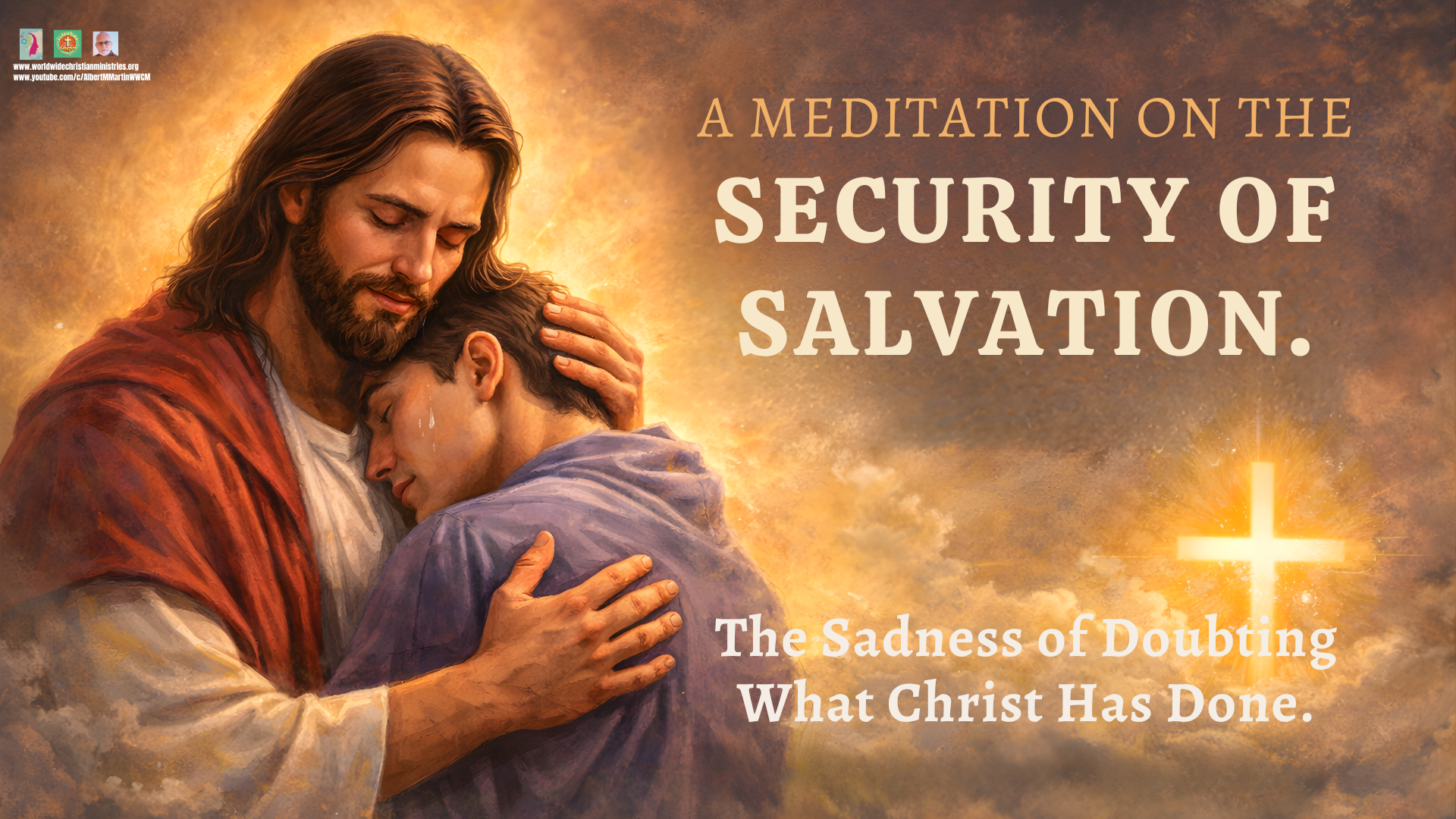
A Meditation on the Security of Salvation.
Introduction:
The Sadness of Doubting What Christ Has Done.
It grieves my heart to hear believers who constantly are doubting their salvation. But I understand the foundations of where it arises and, in this meditation, I hope that anyone reading it who is anxious in respect of their salvation will have their fears relived.
Now, let’s be honest right at the “get go.” There are those who rest in religious behaviour rather than regeneration. There are people who have adopted Christian vocabulary, church attendance, and moral routines without ever being born again. They are the described in the parable that is found in – Matthew 13:24-30 speaking of the “Tares amongst the wheat” as Jesus describes them. For them, a serious examination of their spiritual standing is very appropriate.
But that category of persons is not who we are speaking off and to here in this meditation.
Here we are speaking to the “true believer” who “sins and then panics.” The believer who has a “passing doubt and spirals out of control.” The believer who says, “Oh! I’ve had a terrible thought, have I lost it?” speaking of their salvation. The believer who says, “I’ve failed again, maybe I was never saved.” And believe me, I hear it so very often, and so unnecessarily.
But why? Well! That kind of fear often grows where Christian belief and doctrinal foundations are weak.
In many places today, theological depth has been replaced with vague encouragement. Clear categories have been replaced with emotional atmospheres. And often the strongest teaching people regularly receive comes not from careful exposition but from worship lyrics, which, while powerful emotionally, are not always precise doctrinally.
- MUSIC SHAPES MEMORY.
- EMOTION IMPRINTS TRUTH.
- ATMOSPHERE LINGERS LONGER THAN ARGUMENT.
If that foundation spoken off is shallow, then individual and personal assurance in regard to salvation becomes fragile. But, let me say, biblical assurance does not rest on your emotional consistency. It rests on Christ’s completed work.
“But I Sinned…” Of course you did. So, do I. So does every believer still living in a fallen body. That is part and parcel of our “walk of faith and the battle we have with our old nature” and we are in good company this is what the Apostle Paul said (not doubting his salvation but in regard to sinning) –
“…the power of sin within me keeps sabotaging my best intentions, I obviously need help! I realise that I don’t have what it takes. I can will it, but I can’t do it. I decide to do good, but I don’t really do it; I decide not to do bad, but then I do it anyway. My decisions, such as they are, don’t result in actions. Something has gone wrong deep within me and gets the better of me every time. It happens so regularly that it’s predictable. The moment I decide to do good, sin is there to trip me up. I truly delight in God’s commands, but it’s pretty obvious that not all of me joins in that delight. Parts of me covertly rebel, and just when I least expect it, they take charge. I’ve tried everything and nothing helps. I’m at the end of my rope. Is there no one who can do anything for me? Isn’t that the real question? The answer, thank God, is that Jesus Christ can and does. He acted to set things right in this life of contradictions where I want to serve God with all my heart and mind, but am pulled by the influence of sin to do something totally different.” – Romans 7:17-25 – The Message
So, if sinning once nullified salvation, Paul would be counted out. Peter would never have survived the courtyard denial. Thomas would have been finished after his doubt, and the Corinthian church would have had no hope.
So, what do we initially conclude – The presence of struggle does not prove the absence of salvation but in reveals, that the very grief you feel over sin is evidence of spiritual life.
DEAD HEARTS DO NOT MOURN DISOBEDIENCE. DEAD SOULS. DO NOT FEAR DISHONOURING GOD.
Let’s slow this right down and breathe for a moment.


Salvation is not like your mobile phone slipping from your hand and disappearing into the toilet. It is not like a parcel left on the roof of the car that you suddenly realise is gone once you’ve driven away. You cannot simply “misplace” your salvation and you cannot just “drop” it somewhere between Sunday worship and Monday temptation. Nor can you sin so much that it “rolls under the sofa of your life and vanishes.” It really doesn’t work that way.
That entire way of thinking assumes something that was never true to begin with, that salvation is something you achieved and must now maintain. But Scripture never presents salvation as a reward for moral performance. It presents it as a gift of grace.
And here is a statement that steadies the soul:
“THAT WHICH CANNOT BE OBTAINED THROUGH MORAL PERFECTION – CANNOT BE LOST BY MORAL IMPERFECTION.”
Let that settle for a moment before you move on.
The fact is that you did not climb into salvation by flawless obedience, but you were carried into it by Christ’s obedience. You were not justified because you finally got your act together. You were justified because Jesus finished His work. So how could you possibly “fall out” of something you never earned in the first place?
Salvation was and never has been “Performance-Based.” From beginning to end, salvation is entirely and completely rooted in grace. It’s an either-or scenario – You believe. Or you reject. Those are the only two categories Scripture presents us with.
When you were born again, you did not receive “temporary probationary life.” You received eternal life. And the clue is in the word “eternal.” Eternal does not mean “until your next failure.” It means unending.
When God adopts, He does not experiment.
He makes you family. And family language matters, it’s of the utmost importance. When you were adopted into God’s household, you became a son or daughter. Now think this through carefully. In human families, children may rebel. They may run. They may fall out with their parents. They may grieve them deeply. But their biological or legal status does not evaporate because of a relational tension.
- The relationship may suffer.
- The closeness may weaken.
- The fellowship may be strained.
- But family relationship remains (no matter what.)
So, it is with God.
Yes, the “family resemblance” can become distorted in seasons of sin. Yes, “obedience can falter.” Yes, “growth can stall.” But the filial status does not fluctuate with emotional weather or moral inconsistency.
What changes is not your position – it is your experience.
The Difference Between Salvation and Reward.
There is something believers often confuse: Salvation and Reward. Let’s put this straight right now – Salvation is secured by Christ’s finished work and Reward relates to faithfulness in service.
There is coming a day when we stand before Christ, there is no doubt about it and it is called – the Bema Seat of Christ. It will not be a time of condemnation; that’s not the purpose. No! it is a time of evaluation. Scripture speaks of works being tested. Some may endure. Others may be burned up. There can be loss of reward. “We must all appear before the judgment seat of Christ, so that each of us may receive what is due us for the things done while in the body, whether good or bad” – 2 Corinthians 5:10.
But even in that solemn moment, salvation remains intact. A believer may stand with little to show perhaps entirely spiritually naked. A believer may feel the weight of squandered opportunities. A believer may see what could have been. But they do not cease to be a child of God.
That is why careless living is serious, not because it threatens your salvation, but because it diminishes what God has planned for you – joy, fruitfulness, intimacy, and eternal reward. It also makes life harder than it needs to be. Why? Because, when a believer resists the Spirit’s sanctifying work, there is friction. There is internal unrest. There is discipline. Not because God is trying to evict you, but because He is determined to shape you, shape you into the likeness of Christ.
SANCTIFICATION IS NOT GOD TRYING TO KEEP YOU SAVED. IT IS GOD SHAPING THOSE HE HAS ALREADY SAVED.
Conviction is not eviction.
When you sin, let me say very plainly, what changes is fellowship, not sonship. And confession restores intimacy. It does not re-secure justification. As I mentioned earlier – Eternal Means Eternal.
Let’s come back to that word again – eternal.
If eternal life can be lost, patently it was never eternal. If adoption can be reversed, it was patently never adoption. If justification can be undone, Christ’s work was patently incomplete. But He said, “It is finished.” And finished does not mean “pending review.” Finished means complete.
So, comfortingly, your security is not anchored in how tightly you hold Christ. It is anchored in how firmly He holds you. And He does not drop what the Father has given Him.
Listen to what Jesus declares: “… ‘I have not lost one of those you gave me.’” – John 18:9 – NIV.
Jesus does not say: “I did my best.” He says: “I have not lost one.” That is fulfilment language. That is completion language. That is mission accomplished language.
Security of salvation is not about how tightly you hold Him. It is about how completely He keeps you.
Jesus also said in: John 6:39 – NIV. “And this is the will of him who sent me, that I shall lose none of all those he has given me, but raise them up at the last day.” This is not sentimental reassurance. It’s covenant language.
Jesus is tying security to:
The will of the Father. The giving of a people. The certainty of resurrection.
- Notice the flow: Given – Kept – Raised.
Not:
- Given – Kept (if they behave) – Possibly raised.
The resurrection is not a reward for sustained self-maintenance. It is the guaranteed outcome of those given to the Son. If salvation could evaporate, then the Son fails to accomplish the Father’s will.
So, the question for us is – How Should We Walk? Not carelessly. Not arrogantly. Not presuming upon grace. But absolutely confidently. I hope that you can begin, if anxious or fearful begin to understand that secure children grow best, but fearful children hide and you have no reason to either be anxious or fearful.
When you know you belong, obedience becomes your response, not anxiety management. And, holiness becomes gratitude, not panic. It leaves us not waking up every morning wondering if you are still saved but waking up knowing you are loved.
It’s from that place, you fight sin “not to stay in the family, but because you are in the family.”
A Gentle Word to the Doubting Heart.
If you are constantly asking, “Did I lose it?” If you are scanning your spiritual pulse every hour, taking your blood pressure morning, and evening, or evaluating your cardiac rhythms. If you are frightened by passing thoughts or yesterday’s failure, then let me say:
Pause.
Salvation is not a fragile object balanced on the roof of your car. It is a covenant secured by the blood of Christ. You did not drop it. You did not misplace it. You did not sin it away last Tuesday. You either believed the Gospel – or you rejected it.
If you have believed, and truly rested in Christ, then your security rests in Him, not in your daily performance score.
- Yes, grow.
- Yes, repent quickly.
- Yes, pursue holiness.
- Yes, long for reward.
- But do not live as though you are one difficult day away from spiritual homelessness.
You are a child. And children, even when they stumble, still belong. Walk in that confidence.
Conclusion:
Remember: “Phones fall. Packages get left on car roofs. Human beings misplace things constantly.”
But here’s the key contrast:
PHONES ARE FRAGILE. PARCELS ARE FORGETTABLE.
SALVATION IS NEITHER. YOU CAN DROP A PHONE.
YOU CANNOT DROP ADOPTION.
YOU CAN MISPLACE A DEVICE.
YOU CANNOT MISPLACE ETERNAL LIFE.
Amen
This was a blessed reading
Amen
This was a blessing
Thanks for your God’s message about salvation and all theological study pastor