
What If You’re Meant For More – and the Cross Is The Way There?
Introduction:
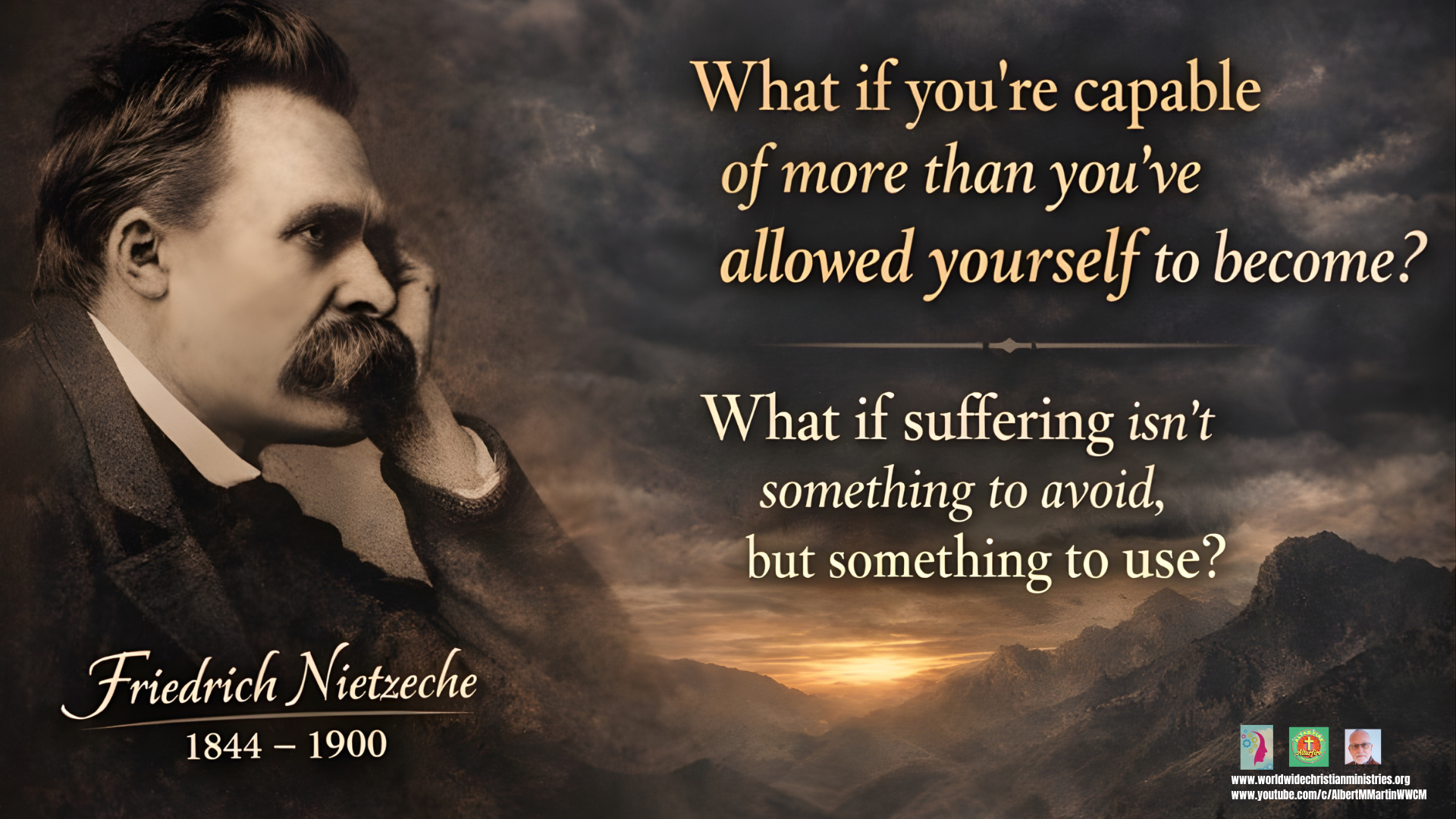
What if you’re capable of so much more than you’ve allowed yourself to become?
What if suffering isn’t something to avoid but something to use?
Sit with that for a moment. Not as a slogan and Not as a motivational line, but as real question about real life, the kind you wrestle with in quiet moments, when things haven’t worked out, when pressure builds, when something in you knows you were made for more than just surviving and getting by.
This idea has floated around philosophy for years — the German philosopher Friedrich Nietzsche presented that line of thinking, but I want gravity to bring it down to where we all actually live, rather than in the clouds of philosophical thinking and reasoning. Because most of us don’t meet suffering in theory – do we? We meet it in our disappointments, loss, strain, confusion, failure, and the slow weight of life not going how we expected. And instinctively, we try to avoid it by distractions, maybe by medicating, perhaps by trying to stay busy or pushing through as if that will help. Anything to get that armchair feeling or warm quilt of comfort.
But, like a wet fish slapping us in the face, the Gospel steps into that instinct and says something both confronting and hopeful at the same time.
The Gospel say’s: It doesn’t start with comfort – It starts with a cross.
Not as a religious symbol, but as the moment God stepped into the worst of human suffering and changed its meaning forever and is still doing so. And let’s be clear here, God does not produce suffering. He is not the author of evil, cruelty, sin, or death – that’s all down to us (even if we don’t like to believe it.) Suffering exists because the world in which we live is fallen, because people wound one another, because creation itself is fractured, and because spiritual opposition is real.
There is a truth however we should not forget and it us that suffering does not occur outside of His sovereignty, and it never escapes His providence. In it all He permits, He governs, He restrains and He redeems through it. But He is not and has never been its source.
How do we qualify this? By looking to the cross as its most clearly seen there.
When we look at the cross and that cannot be achieved without looking at Jesus, we see that Jesus didn’t avoid suffering. He didn’t soften it or bypass it – He entered it. None of His suffering happened as a result of His mistakes, failures or incapacity. No! Human hatred drove it. Political power enforced it, darkness was surrounding it, and sin made it necessary. And yet, still, it unfolded within the foreknowledge and purpose of God, not because God created suffering, but because He rules in a world where suffering exists and is able to bring redemption out of what He did not create.
And that’s where the order becomes everything: The cross comes before resurrection – Always.
We live in a world that wants resurrection, and by resurrection, I mean “change” – I mean “salvation” without crucifixion, growth without surrender, life without death, hope without repentance. But the Gospel is blatantly honest. There is no new life without the old life being surrendered, transformation without the revolutionary truth and certainly no resurrection or salvation without the cross at the very centre of it.
And this goes deeper than what people often reduce faith to. It’s more than raising a hand in a church service, or walking an aisle, it’s more than simply praying a prayer – even though those moments may be part of someone’s turning point. Because the Gospel isn’t presenting a ritual moment, it’s pointing to death and rebirth. Death of Self and Re-birth in Christ – hence He declares “You must be born again.”
It amounts to the end of self-rule and pretending we can fix ourselves. It’s the end of carrying and concealing and denying guilt while trying to stay in control. When these things become our living reality repentance becomes real. We discover a faith that is alive and our surrender follows.
Now come back to that first question.
What if you’re capable of more than you’ve allowed yourself to become?
The straightforward and clear answer the Gospel gives is an unreserved – Yes! But here’s the twist it is not but not in the way we usually think and imagine. We like to think in our desire for “independence and the foolish idea of free will” that it is through – pressure, or through self-reinvention, or by becoming a “better version” of ourselves. But in reality, it’s through being remade or to use Bible terminology “born again.” Or to put it another way, again a Biblical way – “…become a new creature.”
Why? Because left to ourselves, most of us shrink. We learn what keeps us safe, accepted, comfortable. We avoid what stretches us, confronts us, unsettles us. And slowly, we become smaller than we were meant to be, in all senses of the word – spiritually, morally and inwardly.
Jesus never invited people into comfort, He invited them into real life. And, it cannot be avoided, that path always leads through and requires surrender and a declaration of His Lordship. It requires a letting go and a laying things down of things along with facing truth instead of hiding from it. It requires coming to the foot of the cross.
Conclusion:
So, what do we discover today? From a Gospel perspective, suffering is not something to worship, and it is not something God delights in. But it is something He meets us in, and if we surrender to Him, walks with us in and works through.
Because the reality is this: Pressure reveals what we trust in, loss exposes what we’ve built our lives upon on, our personal weakness uncovers our need for grace and suffering without a doubt strips illusion and forces us into honesty.
In Gods intentions it is not to destroy us, but to wake us up.
And if you’re exploring that tension – why suffering exists, how God relates to it, what it forms in us – there’s a YouTube podcast that speaks directly into this area of suffering and providence that you may find worth watching found at the following link: https://www.youtube.com/watch?v=iOOuKqwRXHw
Because in the Gospel story we see that the cross is not the final scene – we see – A stone moves. A grave empties. And life breaks through where death once ruled. Suffering does not get the final word, and the worst of moments is not the end when and where God is involved.
So, this means that if suffering, is in His hands, it’s never meaningless. It becomes the place where our idols collapse and our hearts soften. It becomes the place where faith our becomes real and grace stops being theoretical. Where we discover we were never meant to carry life alone.
So, the questions originally contemplated and raised by Nietzsche namely : What if you’re capable of so much more than you’ve allowed yourself to become? What if suffering isn’t something to avoid but something to use? suddenly meet.
Yes, is the response – you are capable of more than you’ve allowed yourself to become. But not through self-effort alone. But, through surrender by being remade into the likeness of Christ (by being born again.) Not improved but Recreated. And amazingly, often, the very places we’ve tried hardest to avoid become the places where God begins to work most deeply. Not as their cause, but as the Redeemer who meets you within them.
So, this stops being philosophy and it becomes personal.
Let me ask you a question:
What if the life you’ve been protecting is the very thing keeping you from becoming who you were created to be?
What if the pain you’ve been trying to outrun is the place where God wants to meet you?
What if surrender isn’t loss… but the doorway to life?
Because the Gospel is not information to just agree with. It is an invitation for you. It’s not just an emotional moment, it’s a place to bring your fear, your questions, your guilt, your habits, your wounds, your striving – and place them at the foot of the cross.
It’s not a performance, or a ritual, but it’s a time of surrender. A time to turn around, to trust and to lay down the old life, and receive the new one only Christ can give. Why? Because the cross will always come before resurrection. And resurrection is still what God does – in hearts, in lives, in people who come to the end of themselves and discover that Christ meets them there.
So, here’s the invitation.
Come as you are. Bring what hurts. Bring what’s heavy. Bring what you’ve tried to manage, hide, or outrun. Lay it down before Christ.
Not because suffering is good – Not because God produces it.
But because He meets people in the middle of it… and raises them into life.
God Bless You
Albert