
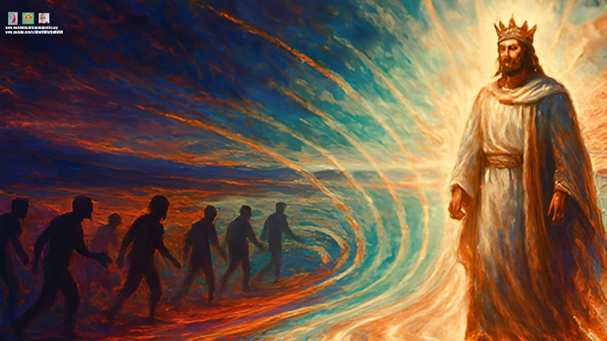
Occupied Territory.
Subtitle: A pastoral meditation on Christ the King, the contested world we live in, and the Gospel as a rescue mission
That subtitle is a declaration of war in New Testament terms. Jesus did not step into a neutral world, then or now, offering humanity a refined moral programme. The modern obsession with “moral code” misses the point entirely. The Gospels do not open on a self-help stage; they open on occupied ground.
He entered a world already under hostile influence and He did not negotiate with it; He moved against it. He came as the rightful King and began the reclaiming. Once you see that, the Gospels cannot be read as gentle spiritual reflections. They read like the advance of a throne into enemy territory – authority confronting usurpation, light pressing into darkness, and the rule of God taking back what has been held under counterfeit powers. This is not a lesson plan. It is liberation. It is conquest. It is the King laying claim to what belongs to Him.
Jesus’ Ministry Was Confrontation – Not Mere Instructional.
Yes, of course, Jesus taught, after all He was the “Greatest Teacher” ever. But do not reduce Him to a lecturer with better ideas. His words were not decorative; they were verdicts. His teaching did not merely inform minds; it summoned surrender. And it was never the centrepiece of His arrival. The centre was authority, authority stepping into disputed territory and taking command.
So, look at the pattern the Gospels refuse to let us ignore. What stands out is not a travelling philosopher offering life tips. What stands out is a King advancing into resistance:
- Demons recognise Him because they know their occupier’s lease is ending.
- Sickness gives way, not after negotiation, but at command.
- Storms submit, creation itself yields to its rightful Lord.
- Religious systems are exposed because counterfeit holiness cannot survive the presence of the Holy One.
- False authority is challenged because usurpers do not get to keep the throne.
That is not the portrait of a man wandering through towns offering insights for better living. That is a King on the march, moving with purpose, pressing into contested ground, establishing a Kingdom that is not earthly in origin, but is absolutely territorial in effect – it claims hearts, breaks chains, and confronts rival rule.
And when Jesus declares, “The kingdom of God has come near,” He is not introducing a fresh concept, floating a new philosophy, or suggesting a spiritual upgrade. He is sounding an alarm that of – The rightful government of God has arrived.
The invasion of Heaven has begun. Light is breaking into land long dominated by darkness, storming human lives, overthrowing hostile rule, and calling every soul to decide where their allegiance will stand.
The Language of “Kingdom” Is Territorial.
Do not soften that word – Kingdom. It is not poetic language. It is not a private spirituality term. It is a territorial claim, the vocabulary of rule, dominion, and rightful authority. The Gospels speak this way because the central issue is not self-esteem, personal fulfilment, or moral refinement. The issue is government. The issue is who reigns.
Scripture assumes two realms, two domains that stand in open conflict – the dominion of darkness and the kingdom of God’s Son. There is no neutral ground. There is no third category. There is transfer or there is captivity. Light or darkness. Christ or another lord.
And that reality shatters, as it did when he was on his earthly ministry and the modern redefinition of evangelism. Evangelism is not mainly intellectual persuasion, emotional appeal, or social improvement. Those may orbit the mission, but they are not the mission. Evangelism is the public announcement of a regime change, the proclamation that a stronger King has arrived and is taking what is His.
That is why the earliest preaching was not delicate. It did not lead with suggestions. It came with commands and claims:
- “Jesus is Lord.”
- “Repent.”
- “Turn.”
- “Be transferred.”
Those are not soft religious phrases. They are words of allegiance, summons to abandon rival rule and come under the rightful King.
Why Mission Is Not Primarily Humanitarian.
Yes, it’s true of course that love must be practical. The Gospel never dismisses human need. But humanitarian work, detached from proclamation, is not the Church’s centre. If the nations are spiritually contested, then feeding the hungry without Christ helps for a moment. Teaching literacy without Him improves circumstances. Working for justice without salvation stabilises systems. Yet none of those dethrone false powers, restore people to God, or change eternal destiny.
The apostolic pattern was always both, tangible love and fearless proclamation, mercy with a message, compassion with authority. Remove proclamation, and the Church slowly becomes a charity. Hold both together, and the Church becomes an outpost of the Kingdom in enemy territory.
Evangelism Is an Allegiance Transfer.
“Make Disciples of All Nations” Is Strategic Warfare.
Scripture describes salvation as movement, an extraction and relocation. From darkness into light. From slavery into freedom. From death into life. From one lordship to another. That is why conversion in the New Testament is decisive, it’s not adopting a belief, joining a group, or adding spirituality, but renouncing former loyalties, confessing a new King, and stepping into a new kingdom.
We should never forget that Jesus did not say, “Make converts.” He said, “Make disciples… of all nations.” Nations matter because culture shapes allegiance, systems shape belief, and spiritual influence often operates collectively. The mission is not only individual rescue; it is Kingdom presence advancing into public life, penetrating cultures, confronting idols, and reshaping loyalties at every level.
That is why the early Church planted communities, challenged magic and idol systems, and proclaimed Christ publicly. They were not merely saving isolated souls; they were establishing footholds of the Kingdom wherever the Gospel took root.
Why This Perspective Has Faded.
This is not an accident. In many places, mission has been quietly rebranded, not denied outright, just domesticated. The Church has been tempted to trade a wartime mandate for a peacetime lifestyle, until the assignment no longer sounds like a commission and more like a community service plan. So, what passes for “mission” in many contexts now gets reduced to: counselling, community support, motivational teaching, ethical guidance.
These things can have a place, of course. But they are not the centre. They are not the spearhead. They are not what Christ died and rose to release. When secondary things become primary, the Church doesn’t just lose emphasis, it loses edge, clarity, and authority.
And here is the root of the drift, when the unseen realm disappears from our thinking, everything else collapses into the natural. Evangelism starts to feel optional. Sin gets renamed as psychology. Repentance gets condemned as “harsh.” And Jesus is slowly repackaged as a life coach instead of proclaimed as Lord. But the New Testament will not allow that downgrade. It does not present Him as a self-help teacher. It names Him for what He is: Deliverer. Liberator. Conqueror. King.
The Rescue Operation Is Still Underway.
The rescue operation is not a memory. It is active. Nothing about the original mission has changed because the battlefield we are all in has not changed.
People today are still:
- spiritually bound, shaped by unseen loyalties, discipled by culture and searching for authority, truth, and meaning, yet rarely asking who is forming them.
So, the Church does not get to drift into silence. The Church does not get to outsource its mandate. The Church does not get to redefine the assignment.
We still carry the same calling:
- Announce the true King.
- Call people to repentance.
- Proclaim forgiveness.
- Confront darkness.
- Disciple nations.
Not aggressively. Not politically. But spiritually, with truth, with authority, and with love that refuses to flatter captivity.
And Here’s the Personal Edge (No Neutral Ground.)
This is not only global mission or theological language. It lands on the human heart.
Every person is already living under some form of rule: Self. Culture. Ideology. Fear. Desire. Or Christ.
The Gospel is the moment of transfer when a person stops treating Jesus as an accessory and bows to Him as Lord. Not merely, “I believe in Jesus.” But: “Jesus is Lord over me.”
That is where rescue becomes real. That is where chains break. That is where a life changes direction – out of darkness and under the rightful King.
The Church at the Crossroads.
The Church either remembers this, or it loses its way. When the Church forgets the cosmic weight of its mission, it does not become neutral; it becomes diminished. It trades authority for administration and urgency for maintenance.
It becomes:
- Managerial, concerned with systems more than souls.
- Therapeutic, soothing wounds without confronting captivity.
- Organisational, busy with activity yet disconnected from assignment.
But when the Church remembers, and when it recovers its true identity and calling, Oh boy! everything changes.
- Prayer regains urgency and depth because the battle is real.
- Worship becomes an act of allegiance, not atmosphere.
- Preaching becomes proclamation, not commentary.
- Evangelism recovers its clarity and necessity because eternity is back in view.
Because the stakes are no longer vague. They are unmistakably clear.
Oh, my Brothers, Sisters fellow Leaders, this was never about building an institution. It has always been about people being brought – Out of darkness, Under Christ, Into life, Into the restoration God has been unfolding since the beginning.
Conclusion – The King Is Still Reclaiming His World.
When you step back and take in the full sweep of Scripture, the picture is unmistakable. The world is not neutral. History is not random. And the Gospel is not about self-improvement or spiritual comfort.
Christ entered a world already marked by rebellion, confusion, and divided loyalties, and He stepped straight into it with authority, compassion, and purpose. Wherever He went, darkness loosened its grip, truth shattered deception, and people were summoned into a new reality: life under the rightful King.
That same reality remains. Today, right now as they were when Jesus was here are found to be – Still searching. Still bound by fear, identity, shame, ideology, and false hope. Still attempting to build meaning without God and still discovering it cannot hold.
And into that very landscape, the Church is sent.
- Not to dominate.
- But to love deeply.
- Not to manipulate.
- But to speak truthfully.
- Not to manage an organisation.
- But to proclaim clearly.
There is a King. There is forgiveness. There is freedom. There is a way back to God.
So, evangelism, then, is not pressure, it is invitation to us all. Our mission is not expansion, (God will Himself add to the Church such as are being saved) – it is rescue. And it’s well for us to remember that discipleship is not behaviour management, it is learning to live under the good, healing, steady authority of Christ.
In addition to that we should keep at the forefront of our thinking that – The Gospel is personal – but it’s never private. And whilst it is individual, it should never be isolated. And It is always essentially spiritual, and we should never let it become abstract.
Why? Because it is God reclaiming people, restoring lives, and re-establishing His Kingdom in the midst of a contested world. And the invitation still stands: Come out of darkness. Come under Christ. Come into life.
The King is still calling – And the rescue is still underway.
Thank you so much for your sharings this